 |
Chinese > Books for learning Chinese >
Highly recommended – Portable, durable and to-the-point.
- ISBN-10: 3468981333
- ISBN-13: 978-3468981333
-
(amazon.com: look inside) (look inside unavailable as of 2013-10-11)
Feel free to change the Amazon.com URL from .com to your language of choice. Odds are good that it’ll be available from another amazon.foo website.
Size – 10.5cm x 15.5cm x 3cm. Particularly small.
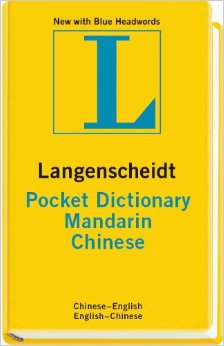
Cover – The cover is spectacular. At a touch it feels durable, vinyl like a three-ring binder I’d bet. It’s slightly oversized compared to the pages, to protect them. Imagine the pages being bound together alone, and then the cover is placed overtop. So the binding of the pages isn’t attached to the outside spine. I get the impression this will make the binding significantly more durable than other books.
Pages – The pages are thin, but don’t seem fragile. They’re bright white. The pages are thin enough and the text dark enough that the back side of a page is slightly visible through. It’s like a blur across the page. It’s not bad though, and it’s a good trade off for portability. There’s a kind of curve to the pages when the book is closed, making it particularly easy to pick up and fan through.
Text – The font is quite small but very clean. Main entries are blue, and make it easy to pick out entries for quick skimming. Actual entries are slightly indented, which helps too. Phrases for entries are bolded, making them similarly easy to pick out. Chinese characters are done in a noticeably thick font, making them a little more difficult to read than with other books.
This book does not have Traditional Chinese characters.
-
Pronunciation, tones
- This book has a simple list, although Reading and Writing Chinese – Third Edition – (2013 book) is more detailed (and complex).
- Radical chart
- Radical index
- Radical index -> Chinese character -> pinyin
-
The first part of the book is: Pinyin -> Chinese character -> English translation(s)
- Occasionally, an entry will have a phrase. Chinese characters -> pinyin words -> English translation.
- There are a couple of pages of dashed blue lines, which makes it easy to find the second part of the book.
-
The second part of the book is: English word -> Chinese character(s) -> pinyin word(s). Many entries are multiple-word.
- Occasionally, an entry will have more than one translation. There are subtleties in English, where a word can be used in different contexts and mean a different thing. For example, “absence” has multiple translations in Chinese: of person, from (school/work), lack.
- Occasionally, an entry will have a phrase. English words -> Chinese character(s) -> pinyin word(s)
- Taiwanese equivalent tables for a few pages of words and phrases: English -> pinyin -> Chinese characters ==> pinyin -> Chinese character(s)
-
Numbers

