 |
Commodore 64 + Music > Commodore SID >
All information should be free from restriction and immortal, and this applies to music; the one thing which any everyday person is most enthusiastic about. We want to find and share it. But most importantly, we want to keep it alive .
Imagine finding your favourite artist and your favourite song. Then imagine it being lost, unavailable.. forever. The song itself may become a vague memory in time, but there will always be that sadness in you. With regular software or other media there is the occasional archivist who will collect and catalog things.
With music, everyone becomes an archivist .
On Music ∞
Music has been the most captivating element in computing. From the first song played by a computer using electromagnetic interference right down to your extremely closed and un-free Evil iPod. In early computing, music was unheard of; the technology just wasn’t there. But as soon as it became even remotely possible there was a huge effort to make the most of it.
The Commodore 64 is one of the pillars in oldschool audio. With some fairly simple technology, programmers became musicians. It’s early music was crude, like the knowledge used to create it. But at some point several extraordinary people rose from the crowd. With their new techniques and ideas they made waves that forever changed the way everyone worked. In time, tens of thousands of songs were created; in games; crack intros; demos; and as separate pieces of music. This is real music , with a timeless style and sound all its own.
Alongside the Commodore 64, the Atari and the Amiga music scenes were creating their own unique styles. But all of these music scenes declined when the marketplace changed. Some change was due to audio technology evolving – more realistic audio – and some change was because the computers themselves were being obsoleted by newer products and different platforms.
There are always archivists cataloguing music, but that effort became more widespread in the early 90s when that decline was felt most strongly. Several projects committed sizeable effort towards preserving everything they could. The internet was still an expensive thing back then, so hosting was a particular challenge; especially to young adults in college.
Emulation projects began, particularly for playing all that old music. However, a number of other projects which had higher ideals. Terms like “cycle accurate playback” were argued for. A couple of interesting ISA cards were produced, one of which was the HardSID. It allowed a user to take the actual physical sound chip from one of their Commodore 64s and plug it into the card and use it on an Intel x86 machine. That was 1999. I bought one. The Wikipedia has some other devices listed on their MOS Technology SID page.
HardSID ∞
(HardSID)
2015-06-21 update: HardSID has been gone for some time now. =(
A couple of projects have remained, and the HardSID is one of them. Because of the small market it’s only been a side-business, but they’ve managed to keep their technology up-to-date. A PCI card was produced, and I wanted to save up to buy one. But I waited too long and it was discontinued; they were all bought! Then USB devices were created. This was decided to be a better long-term solution, and it played truer-quality audio.
But those USB devices were extremely high-end, meant more for producers and serious collectors. I didn’t have the budget to buy one. But now that’s changing. No, I don’t mean my budget (sigh).. I mean the technology.
HardSID has come out with a couple of new products:
 HardSID Uno UPlay
|
 HardSID HS4U
|
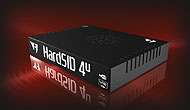
The left picture is what the two new products look like; the Uno and the UPlay. On the right is the existing professional-quality device; the 4U Studio Edition.
These devices give you extremely accurate and high-quality playback of Commodore 64 music.
Emulation ∞
Unity Linux users can enjoy some of the audio using an emulator. Audacious has a plugin which works reasonably enough, although I remember it used to display all the sub-songs in its playlist and now it doesn’t seem to be doing that.
su -c 'smart install audacious-sid'
SID collections ∞
The de facto standard SID collection is the HVSC (High Voltage Sid Collection). It’s so large that there are other projects to help filter through it all, like best of VARIOUS.
There was a magazine which also released music, called COMPUTE!’s Gazette and it has an archive called the CGSC (COMPUTE! Gazette SID Collection)
Other jukeboxes exist, such as one the HardSID Jukebox.
But if you want the real quality that only an actual Commodore 64 can produce, with no possible quality loss through emulation or a hardware product, then you must check out SOASC (Stone Oakvalley’s Authentic SID Collection). They record on actual hardware and convert them into mp3s!

