Software >
Consolidates as many diagnostic tools as possible into one bootable CD/USB stick.
2009-04-10 – 4.1.1 ∞
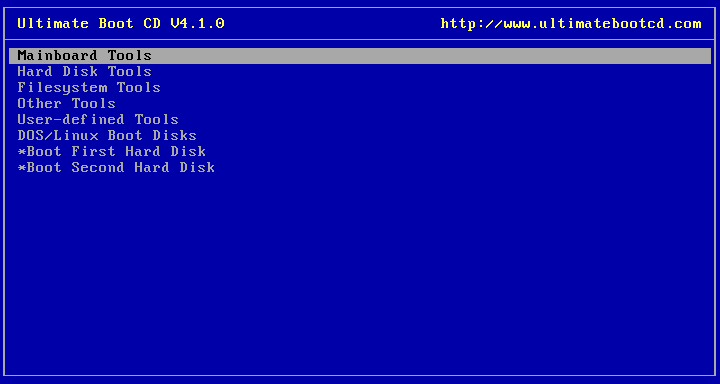
I’ve known about this beauty for some time now, and I think I might have briefly tried it some time ago.
I have the greatest respect for forks and compilations and remasters, because it means that someone had the skill and will to take something they liked, and make it even better. It means that if I like the philosophies of that person, I will be much more inclined to like everything they have a hand in.
I had a really positive pre-impression, and a very positive first impression. Menus that are easy to walk through, lots and lots of software. Enough DOS software to make an oldschooler like me grin, if only that it’ll baffle noobs.
The reason I got this, was because I was interested in trying gujin out, and Ultimate Boot CD had it.
Gujin seems really wonderful and capable and all that jazz, and it even provides a binary. The problem is that it’s opaque to regular humans. There is simply no way to use it.

However, because they had a reference that it was included in Ultimate Boot CD, I still had a way to check it out.
Again, I liked Ultimate Boot CD. It made me feel good. But Gujin fell down hard, and spat out some error messages and generally refused to start up. I don’t care to troubleshoot, so that falls down.
I decided to play with some of the other bootloader-related stuff. Some craptastic DOS software which was supposed to understand Linux ended up splatting my MBR. Thanks guys.
Ultimate Boot CD does also come with
- tomsrtbt 2.0.103
- BasicLinux 3.40
-
Trinux 0.89 (the currently-stable version, not the currently-unstable Ubuntu version)
None of these did it for me either.
This is what started my chase for recovery CDs.
I’ll admit my bias. Every time I’ve had issues with a bootloader I’ve been able to pull out Slackware 7.1 or 8 and get things fixed in no time flat. Every time. I’ve had erratic success with anything else, and 100% success with Slackware. Yes, 100%.
But.
I didn’t have my Slackware disks anymore. I don’t know what I was thinking to ever get rid of them. The glare from those shiny desktop distributions must have disoriented me.
So I decided to go looking for some Slackware-based rescue disks.
Oh, and because it needs to be said: Slackware’s first install disk is also bootable as a console LiveCD. It is, however, a full CD download. This was bigger than I wanted, and it was unspecialized. I did want to get my hands on some rescue disks to see what they had to offer.

